
Resume Templates for Data Science Roles
Table of Contents
- Why Resume Templates Matter for Data Science Roles
- Data Scientist Resume Examples: Entry-Level vs. Senior Structure
- ATS-Friendly Resume Format for Data Science
- How to List Machine Learning Projects on Your Resume
- Data Science Resume Length: How Long Should It Be?
- 6 Resume Templates for Data Science Professionals
- 1. BigDataResumes: Specialized Playbooks for Data Roles
- 2. Enhancv: Modern Design with Real-Time ATS Feedback
- 3. Resume Worded: AI-Powered Optimization for Job Descriptions
- 4. Overleaf: LaTeX-Based Technical Precision
- 5. ResumeTemplates.com: Affordable, Quantified Impact Focus
- 6. Notion Template: Free, Portfolio-Integrated Approach
- Common Mistakes to Avoid in Data Science Resumes
- Essential Skills and Sections Every Data Science Resume Needs
- Frequently Asked Questions
Last Updated: September 3, 2026
Why Resume Templates Matter for Data Science Roles
Most hiring managers spend 6-8 seconds scanning each application (eeoc.gov). For data science roles, that initial scan determines whether your technical qualifications reach a recruiter or whether an ATS silently discards your application before a human sees it.
Resume templates for data science roles are critical. A well-structured template ensures your skills, projects, and impact reach hiring teams.
Data science resumes demand a specific architecture: machine learning projects, quantified model performance, technical stack, and business impact, all ATS-compliant. Generic templates fail because they lack technical depth, break under ATS parsing, and don’t highlight the problem solved, methods used, and measurable outcomes.
The best data science resume templates include sections for GitHub repositories and portfolio links. This separates you immediately from candidates who only list job titles and responsibilities.
Data Scientist Resume Examples: Entry-Level vs. Senior Structure
Entry-level resumes emphasize projects, coursework, and technical skills. Senior resumes lead with impact: models deployed, teams built, revenue influenced, infrastructure scaled.
Entry-level structure prioritizes projects and education. Feature a dedicated “Projects” section with 2-4 real machine learning projects, including problem statement, approach, technical stack, and measurable results. A GitHub repository link is non-negotiable, it’s your proof of competency.
Senior structure emphasizes professional experience, scope, scale, and strategic impact. Instead of “Built a predictive model,” write “Led cross-functional team to deploy demand forecasting model, reducing inventory costs by 18% annually across 12 product lines.”
Mid-level data scientists (3-7 years) need both. Highlight strongest projects anchored in employment history, showing progression from individual contributor to strategic impact.
Entry-level resumes should feature a dedicated Projects section with GitHub links. Senior resumes should lead with business impact [metrics and](/how-to-quantify-resume-achievements/) team scope.
ATS-Friendly Resume Format for Data Science
Keyword Placement and Technical Stack Visibility
ATS systems scan for specific keywords before humans review resumes. If your resume lacks skills listed in the job description, the ATS filters it out automatically.
Your technical stack should appear in three places: a dedicated “Technical Skills” section, within project descriptions, and throughout professional experience bullets. If a job posting emphasizes Python, SQL, and machine learning, these terms should appear multiple times naturally across your resume.
The “Technical Skills” section itself should list your proficiencies clearly. Use this format:
Languages: Python, R, SQL, Java
Machine Learning & Data Science: Scikit-learn, TensorFlow, PyTorch, XGBoost, predictive modeling, statistical analysis
Data Visualization: Tableau, Power BI, Matplotlib, Seaborn
Cloud & Big Data: AWS (S3, EC2, SageMaker), Azure, Spark, Hadoop
Databases: PostgreSQL, MongoDB, MySQL, Snowflake
This layout is ATS-friendly because it uses clear category headers and lists skills linearly without special formatting that breaks parsers.
Formatting Rules That Don’t Break ATS Parsers
ATS systems struggle with fancy formatting: columns, tables, graphics, unusual fonts, and complex layouts confuse parsers and cause skipped sections.
Use standard fonts (Arial, Calibri, Times New Roman), margins between 0.5-1 inch, simple bullet points, and no tables or multi-column layouts (the American Dental Association). Use clear, standard headers: “Experience,” “Skills,” “Education,” “Projects.”
Use consistent date formats (Month Year – Month Year or MM/YYYY – MM/YYYY) to signal standard structure to ATS.
Use single spacing within sections with blank lines between them. Save as PDF to preserve formatting; Word documents render differently across hiring systems.
Avoid graphics, logos, icons, and colored text. ATS systems often interpret these as errors or skip them entirely. A plain, text-heavy resume passes ATS filters far more reliably than a visually designed one.
How to List Machine Learning Projects on Your Resume
Quantifying Impact with Metrics and KPIs
Machine learning projects are your competitive advantage. Quantify impact using metrics and KPIs that hiring managers understand, not just project titles and technical stacks.
Instead of “Built a classification model using Python and scikit-learn,” write: “Developed a customer churn prediction model (logistic regression, 87% accuracy) that identified at-risk accounts, enabling targeted retention campaigns that reduced churn by 12% and saved $240K annually (peer-reviewed research).” Include the specific problem, technical approach, performance metric, business outcome, and financial impact.
Hiring managers prioritize business impact over technical sophistication. A model with 78% accuracy that saves money is more impressive than 95% accuracy with no business value.
Use model performance metrics (accuracy, precision, recall, F1 score, AUC-ROC, MAE, RMSE) and business impact metrics (revenue increase, cost savings, time saved, conversion rate improvement, engagement lift).
Linking to GitHub and Portfolio Evidence
Always link to your GitHub repository when describing projects. Format clearly: Churn Prediction Model | Python, Scikit-learn, Pandas | GitHub. The repository should have a clear README explaining the project, data, methodology, and results. Clean, commented code demonstrating version control and documentation is table stakes for data science roles.
Data Science Resume Length: How Long Should It Be?
Entry-level: one page (education, key projects, technical skills). Mid-level (3-7 years): one to one-and-a-half pages (strongest projects and relevant experience). Senior (7+ years): two pages (successful projects, team leadership, strategic impact). Be selective in all cases.
Every line should answer: Does this show I can do this job? Does this demonstrate impact? Does this prove I have required technical skills? If no, delete it.
6 Resume Templates for Data Science Professionals
1. BigDataResumes: Specialized Playbooks for Data Roles
BigDataResumes provides actionable playbooks for data engineers, data scientists, and ML professionals. It focuses on ATS optimization, identifying legitimate job postings versus ghost jobs, and technical interview preparation. Best for professionals seeking strategic guidance tailored to the current market, not generic resume builders.
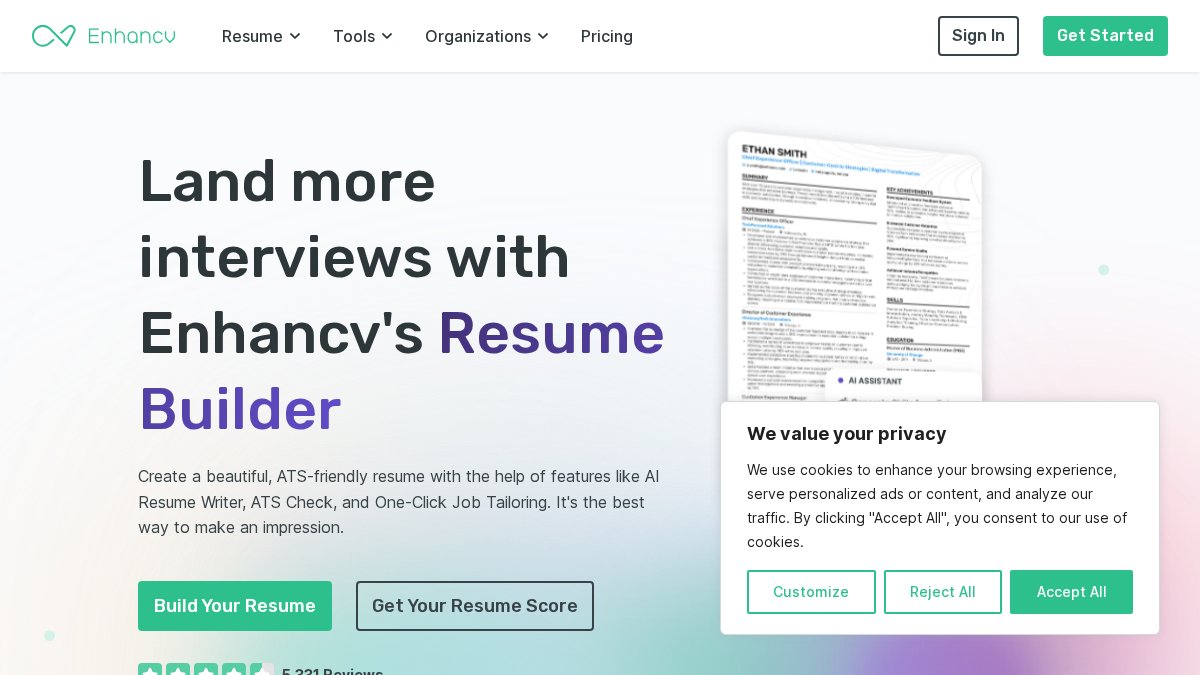
2. Enhancv: Modern Design with Real-Time ATS Feedback
Enhancv is a web-based resume builder with drag-and-drop customization and real-time ATS feedback. It scores content and formatting against ATS requirements and includes content suggestions for technical roles. Data science templates emphasize modern design with sections for GitHub, portfolio links, and projects. Best for professionals seeking visually polished, ATS-compatible resumes with real-time feedback.
3. Resume Worded: AI-Powered Optimization for Job Descriptions
Resume Worded uses AI to score your resume against specific job descriptions. It highlights missing keywords, suggests bullet point improvements, and scores alignment with job requirements. Data science templates include ML projects, technical proficiencies, and quantified impact. Best for data scientists seeking AI-powered feedback on job-specific resume matching.
4. Overleaf: LaTeX-Based Technical Precision
Overleaf offers a professional LaTeX template for technical roles with clean, modular sections customizable through code. It produces a minimalist, academic-style resume emphasizing content over design. The template is free, highly customizable, and supports version control via Git. Best for LaTeX-comfortable data scientists preferring technical aesthetics and complete formatting control.
5. ResumeTemplates.com: Affordable, Quantified Impact Focus
ResumeTemplates.com offers industry-specific templates with pre-written bullet points for common project types. It provides ATS-compliant structures in multiple formats (Word, Google Docs, PDF) with guidance on technical stacks, business-friendly ML explanations, and quantified outcomes. Best for budget-conscious job seekers needing quick, reliable templates.
6. Notion Template: Free, Portfolio-Integrated Approach
Notion-based templates offer flexibility and integration with project documentation. The modular structure organizes your resume alongside portfolio, project notes, and career planning in one workspace. It exports to PDF while maintaining a clean layout. The template is free and highly flexible. Best for Notion users wanting to maintain resume and portfolio in one integrated workspace.

Common Mistakes to Avoid in Data Science Resumes
Avoid vagueness: “Deployed a gradient boosting model (XGBoost) that improved prediction accuracy from 71% to 84%, enabling sales to prioritize high-probability leads and increase conversion rates by 9%” beats “Worked with machine learning models.” Ignore ATS requirements and your application gets filtered. Embed skills in context: “Built ETL pipeline in Python and SQL to automate data ingestion, reducing manual processing time by 6 hours weekly.” Tailor your resume for each role, highlighting relevant skills and experience. For experienced professionals (5+ years), lead with professional history; education goes at the bottom.
Never use personal pronouns (“I,” “me,” “my”) on your resume. Use action verbs and active voice: “Led,” “Developed,” “Deployed,” not “I led,” “I developed,” “I deployed.”
Essential Skills and Sections Every Data Science Resume Needs
Technical Proficiency: Python, SQL, and Beyond
Python and SQL are table stakes for data science roles. Demonstrate proficiency with specific libraries: Pandas, NumPy, Scikit-learn, TensorFlow, PyTorch for Python; query optimization and database design for SQL. Emphasize the technical stack relevant to your target roles. Include both breadth (“Python, R, SQL, Java, Scala”) and depth (“Python: Pandas, NumPy, Scikit-learn, TensorFlow”).
Professional Summary That Stands Out
A strong professional summary is 2-3 sentences answering: Who are you? What’s your core expertise? What value do you bring? Generic: “Experienced data scientist with strong technical skills and passion for machine learning.” Targeted: “Data scientist with 4 years building production ML models for e-commerce. Specialized in recommendation systems and demand forecasting; deployed models improving revenue by 15% and reducing inventory costs by 12%.” Tailor for each role.
Certifications and Education Sections
List degree, institution, and graduation date. Include GPA only if 3.7 or higher. Include relevant certifications (Google Cloud Professional Data Engineer, AWS Certified Machine Learning Specialty, Coursera, DataCamp) with name, issuing organization, and date. For entry-level candidates, include relevant coursework (Machine Learning, Statistical Analysis, Deep Learning, NLP) to signal technical breadth.
Building a strong data science resume requires balancing technical depth, quantified impact, and ATS optimization. Content matters more than template design. A candidate who clearly articulates technical approach, quantifies impact, and links to portfolio evidence outperforms one with a prettier resume and vague descriptions. Focus on substance first, design second. BigDataResumes offers specialized guidance on resume strategy, ATS optimization, and identifying legitimate opportunities tailored to data professionals.
| Template | Best For | Key Feature | Cost |
|---|---|---|---|
| BigDataResumes | Data professionals seeking strategic guidance | ATS optimization + ghost job identification | See website for current pricing |
| Enhancv | Modern design with ATS feedback | Real-time ATS scoring | $14.99/month |
| Resume Worded | Job-specific optimization | AI matching against job descriptions | $19/month |
| Overleaf | Technical candidates | LaTeX precision and customization | Free |
| ResumeTemplates.com | Budget-conscious candidates | Pre-written impact-focused bullets | See website for current pricing |
| Notion Template | Notion users | Portfolio integration | Free |
Frequently Asked Questions
What should a data science resume look like?
A data science resume should lead with a professional summary, followed by technical skills, work experience, and projects. Use reverse-chronological order for employment history. Highlight machine learning projects with quantified results, include your technical stack (Python, SQL, AWS, Tableau), and ensure it’s ATS-friendly with clear section headers. Keep it to one page if entry-level, two pages if senior. Use bullet points with action verbs like ‘developed,’ ‘optimized,’ or ‘deployed’ to describe accomplishments.
How do I format a data science resume for ATS?
Format your resume as a simple .docx or PDF with standard fonts like Arial or Calibri. Use standard section headers (Experience, Skills, Education), avoid tables and graphics, and include relevant keywords from the job description. Stick to left alignment, use bullet points instead of text blocks, and keep margins at least 0.5 inches. Don’t use headers/footers, columns, or creative formatting that ATS systems can’t parse. Incorporate semantic terms like ‘machine learning,’ ‘predictive modeling,’ and ‘statistical analysis’ naturally throughout.
How do I list machine learning projects on my resume?
List projects under a dedicated ‘Projects’ or ‘Portfolio’ section with the project title, tools used, and impact. Use this format: Project Name | Tools (Python, TensorFlow, AWS) | Brief description with quantified outcome. Example: ‘Developed customer churn prediction model using gradient boosting that improved retention by 15%.’ Include links to your GitHub repository or portfolio site. Focus on business impact (revenue, efficiency gains, accuracy improvements) rather than technical details. Emphasize the problem solved, methods used, and measurable results.
Should a data science resume be one or two pages?
Entry-level data scientists should aim for one page to keep focus tight and respect recruiter scanning time. Senior data professionals with 5+ years of experience can use two pages to showcase depth of projects and leadership. Either way, prioritize relevance over length. Remove outdated projects, non-technical roles, or skills no longer applicable to data roles. Recruiters spend about 6 seconds scanning a resume, so every line must earn its place. Use white space effectively to make content scannable.
What technical skills should I highlight on a data science resume?
Prioritize skills that match the job description. Core technical skills include Python, SQL, R, machine learning frameworks (scikit-learn, TensorFlow), cloud platforms (AWS, Azure), and data visualization tools (Tableau, Power BI). Include statistical analysis, deep learning, natural language processing, and big data tools if relevant. List soft skills like cross-functional collaboration, data storytelling, and business acumen. Place technical skills in a dedicated section near the top, organized by category (Languages, ML/AI, Databases, Cloud, Visualization) so ATS systems can easily identify them.
This article was written using GrandRanker